How much should you keep in checking?
The usual answers are a month of expenses or a round number. The real one is a date.
Ask around and you'll get the same handful of answers. A month of expenses. Two paychecks. A thousand dollars, because that's what the emergency fund advice says. None of them is wrong, exactly. They just answer a different question. None of them knows when your rent comes out, when you get paid, or that your car insurance lands three days before you do.
The number you need is smaller and more specific than any of those: how much has to be sitting in checking on the worst day of your month so that nothing bounces and you don't end up moving money around at the last minute.
The worst day has a date
Most months have one day where the balance is lower than on any other. It's usually somewhere in the middle, after a run of bills has cleared and before the next check lands. If you have enough on that day, you have enough all month. If you don't, no amount of "average monthly expenses" arithmetic helps, because averages don't know about the 14th.
Here's a month that looks fine at both ends and isn't fine in the middle.
| Day | What happened | Balance |
|---|---|---|
| 1st | Paycheck | $2,600 |
| 3rd | Rent, $1,150 | $1,450 |
| 9th | Car payment and insurance, $415 | $1,035 |
| 14th | Groceries, gas, a subscription, $280 | $755 |
| 15th | Paycheck | Back above where it started |
The month starts at $2,600 and ends higher. The day that decides whether it felt calm is the 14th, at $755. If the least you're comfortable seeing in the account is $500, that month was fine. If it's $800, the same month felt tight, and nothing went wrong to make it so.
Pick a floor, then find the day
Two numbers, and they do different jobs.
The floor is the amount you never want the balance to go under. Some people set it at zero and lean on overdraft protection. Most people want more than that, because a floor of zero means you only hear about a problem once you're already in it. There's no formula for it. A few hundred dollars is common. Enough to absorb one surprise bill is a decent rule if you want one.
The low point is the day your balance gets closest to that floor, and finding it takes a calendar with your paychecks and bills on their actual dates.
In Forecast Commander the floor is a field on each account. On a checking account it's called the Safety Floor.
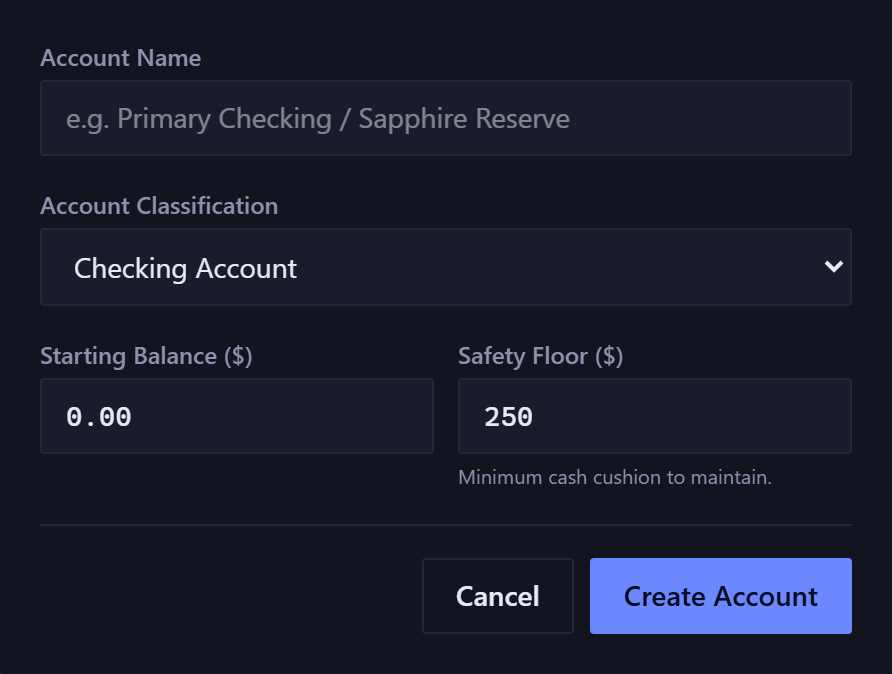
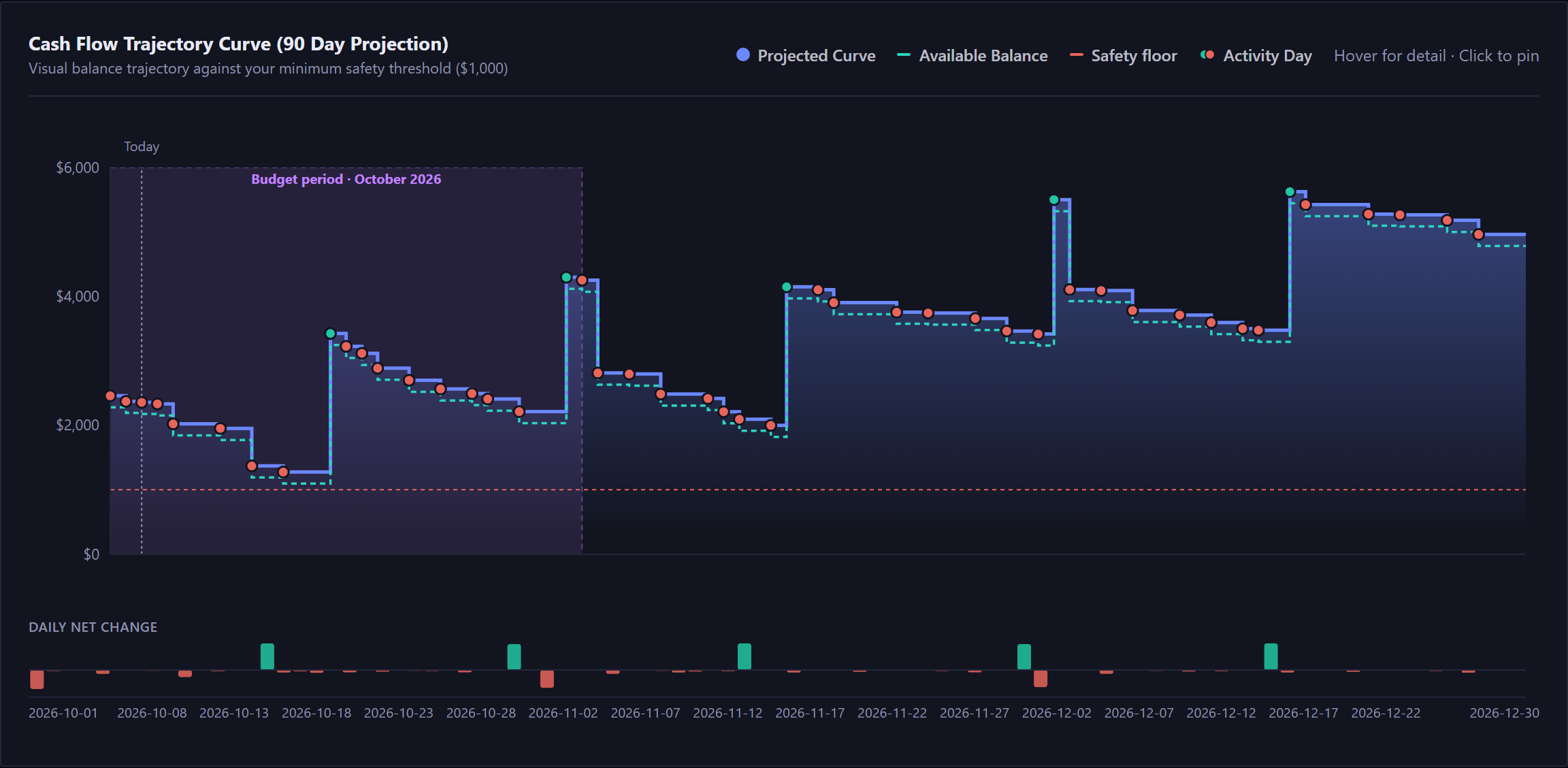
Once it's set, everything that warns you is measured against it: the sentence at the top of the Command Center, the dashed line on the chart, and the red day on the calendar when there is one.
What to do with the answer
If your low point clears the floor with plenty of room, you're keeping more in checking than you need to. That isn't a disaster, but it's money that could be earning something or paying something down.
If it doesn't clear, you have three moves. Move a bill's due date, since many billers let you pick one. Move money in before that day. Or lower the floor for a month and decide whether you can live with how that feels. What you don't have to do is carry a whole month of expenses in checking to solve a problem that lives on one day.
When the number changes
Rent goes up, a subscription gets added, a paycheck shifts a day. Each of those moves the low point a little. So keep the calendar: the app redoes the arithmetic every time something changes, and the sentence at the top tells you the new date.
The 35-day trial is free and needs no card, and the floor is a field on the first account you add. Read about the safety floor.