The number your bank balance is hiding
Everyone knows their balance. Almost nobody knows the day it runs lowest.
Most people know their bank balance. Many know roughly what they spend in a month. Some know their net worth. Very few can answer the question that decides whether the next two weeks feel calm or tense: when does money run lowest?
On one day, usually somewhere in the middle of the month, when several bills have landed and the next paycheck hasn't.
Forecast Commander calls that day the low point. It's one number and one date, and once you have it, most other money questions turn out to be this question wearing a different coat.
The three questions most software answers
Where did my money go? Spending trackers and budgeting apps are good at this. They tell you what went to groceries, what went to dining out, whether you stayed inside the plan. Useful, and it says nothing about next Tuesday.
How much do I have today? Your bank is good at this, and only this. A balance is a record of what has already happened. It doesn't know about the insurance payment due on the 5th, the subscription renewing tomorrow, or the paycheck landing Friday. Your bank knows the past. It doesn't know your plans.
How much will I have at the end of the month? Some forecasting tools stop here. The trouble is that financial stress rarely arrives on the 30th. It arrives on the 14th, when rent, the car payment and the insurance have all cleared and payday is still three days out.
What the low point is
The lowest your balance will reach before it starts climbing again.
Take a month that looks fine on paper:
| Date | Balance |
|---|---|
| Sept 1 | $4,000 |
| Sept 5 | $2,800 |
| Sept 10 | $1,400 |
| Sept 14 | $475 |
| Sept 16 | $2,975 |
| Sept 30 | $2,300 |
A month-end forecast reports $2,300. The low point reports $475 on September 14. Nothing was over plan and nothing went negative, but for four days in the middle there was almost nothing to spare. Only one of those two numbers would have told you that in advance.
When the bills land
A budget can balance to the dollar and still hurt. Rent on the 1st, the car on the 3rd, insurance on the 5th, payday on the 7th: every line fits, and for six days the account is thin. Budgets are about totals. Pressure is about timing. The low point is a timing number, so it catches what a balanced budget misses.
Where the number comes from
Forecast Commander carries your balance forward, day by day, through the commitments you've already made: scheduled bills, recurring subscriptions, loan and card payments, Buy Now, Pay Later installments, and the income you've entered. It's arithmetic, not prediction. When it's wrong, something you entered has changed, and there's a specific line to fix.
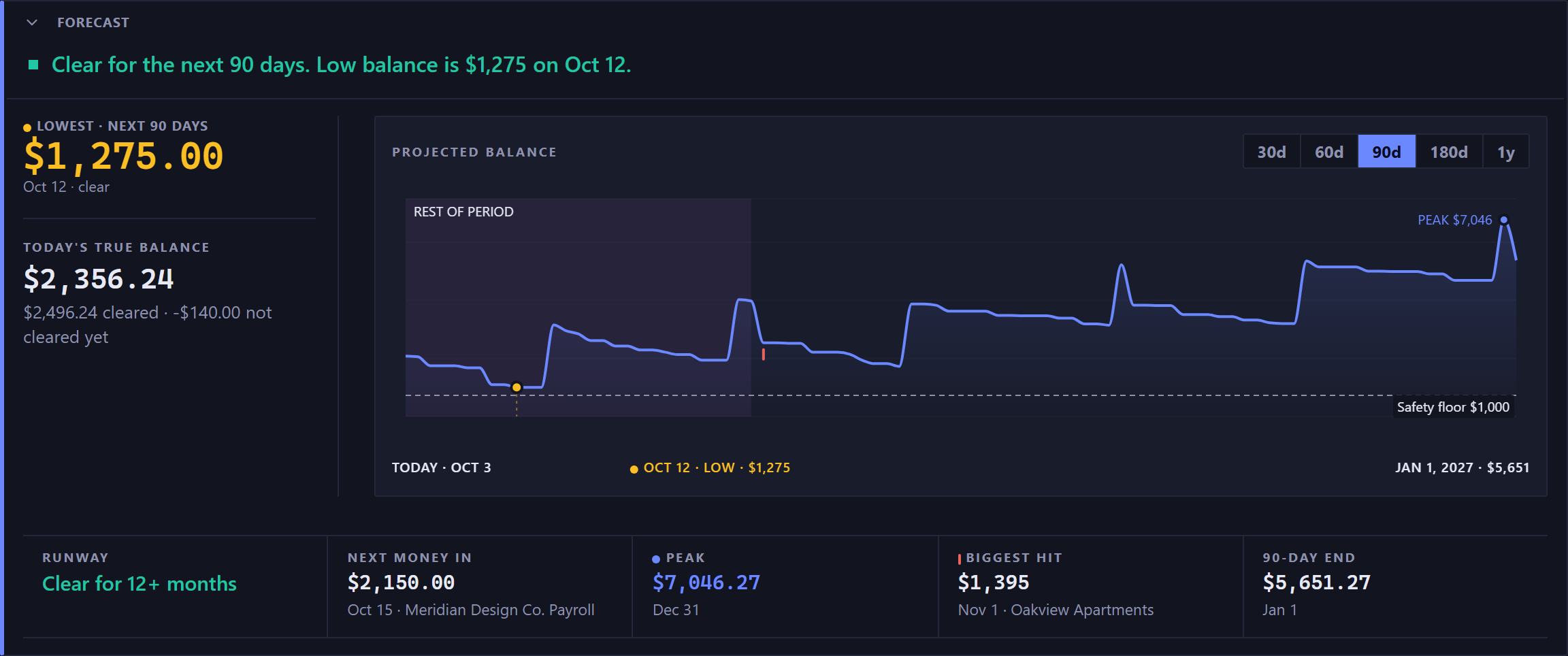
The low point is what falls out of that walk: the day the balance stops falling. The forecast panel says it at the top: Clear for the next 90 days. Low balance is $1,275.
Most budget questions are low-point questions
Can I raise the dining budget? The real question is what it does to the lowest day. Moving the low point from $1,500 to $1,400 is fine. Moving it from $250 to $50 is a different conversation, and it's the same $100 either way.
Can I start a new savings goal? A goal holds money back without moving it, so it lowers your available balance and leaves the low point where it is. The chart draws your available balance as a second line beneath the forecast, so you can see what your goals are holding.
Can I afford this? Scenarios exist for exactly this. Model the purchase, the raise, the canceled subscription, and read the answer in plain words: yes, comfortably; yes, but it spends money you set aside; yes, and it is tight; no, not as planned. Each of those is a sentence about the low point.
Being short and feeling short
Plenty of people have enough money and still spend two weeks a month uneasy, because they can't see when it will be needed. The low point turns that into a date and a figure: when it gets tight, how tight, whether it crosses your safety floor, how much room is left. That makes the worry specific, and that's most of the relief.
One model, one question
Bills and paychecks move the low point. Debt payments, card payments and installment plans move it. Scenarios test what would move it. Together they're one forecast, read from several sides, and every side is answering the same question: what does this commitment do to my lowest day?
If you already budget by envelopes or by paycheck, none of this replaces that. The categories, the periods, the rollover, and the on-plan or over-plan verdict are all still there. The low point is what the forecast adds.
What it needs from you
The forecast only knows what you've told it. Enter the bills, the paydays and the plans as they really are, and the low point is as true as those entries.
See how the forecast is built: A cash flow forecast for your household. See what it asks first when you want something: Scenarios.
No card is needed for the 35 days, and the forecast starts from the balance you type in. Read the Command Center guide.