Looking for a PocketGuard alternative?
PocketGuard's idea is a good one: once the necessities are budgeted for, here's what you have left to spend. One number, updated from your accounts, on your phone and your watch. We make a competing budgeting app, so allow for that as you read. Here's what PocketGuard gets right.
What PocketGuard gets right
The leftover number: what you have left to spend after budgeting for necessities. PocketGuard connects to a very large set of institutions through several data providers, tracks recurring bills and subscriptions, offers a tool for canceling the ones you don't want, builds a debt payoff plan that compares approaches and names the date you'll be debt-free, and shows net worth. It supports custom, zero-based, 50/30/20 and envelope budgeting, and runs on the web, iPhone, Android and Apple Watch. That's a lot of product, and the number at its center is the right one to put there.
Today's number and the 22nd
The number is today's. Whether the card can be paid on the 22nd when payday is the 25th is a different question, and one number can't hold a date.
The second reason is the feed: in Forbes Advisor's 2026 testing, bank syncing and connectivity dominated the negative reviews across the category, and a number computed from a feed is only as current as the feed.
The third is where a forecast comes from. PocketGuard's Pace feature, in its own words, learns your spending patterns, and a projection built from your habits extends what has happened. One built from what you've told it can hold the plan you signed yesterday before it's happened once.
The number, for every day ahead
Keep the one number, and ask for it on every day ahead: a calendar with every bill and paycheck on its date and the balance you'll have that day, and one sentence saying how long you stay above your floor and when your balance is lowest. Budget periods that follow your paycheck belong on the list, with a payoff plan in the same place reading the same figures, and no credentials to hand over unless you choose to.
Your number, drawn forward
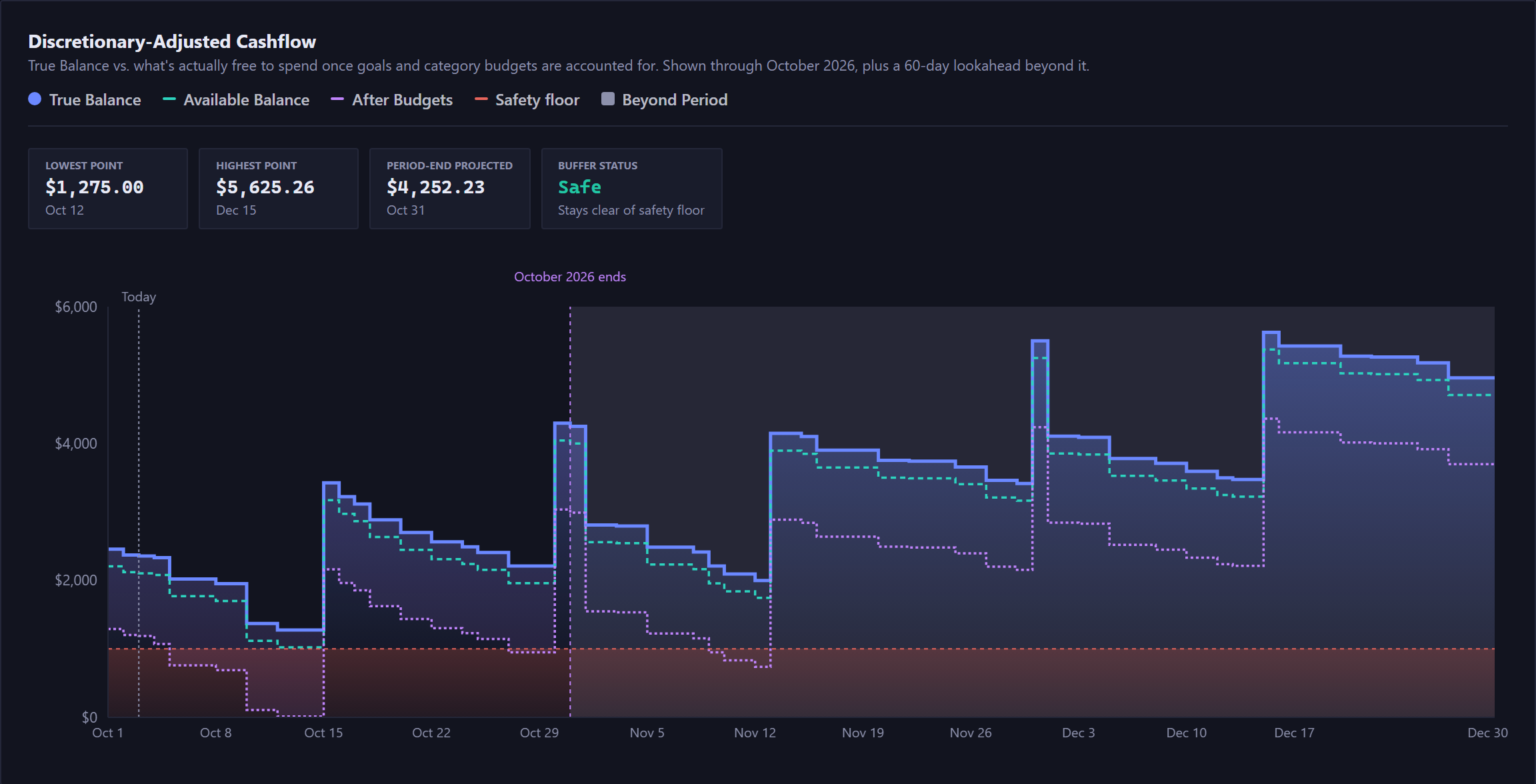
Forecast Commander is a complete budgeting app. The equation on the Budgets page runs from your true balance, through what's scheduled and what's budgeted, to what's unassigned. Unassigned is PocketGuard's number by another name, and the Projection tab draws it forward for every day of the period.
A 50/30/20 split works here too: give a category group its share of income, and the target follows the period's income.
The calendar carries every bill and paycheck on its date, the forecast reads it back as a sentence, and the Debt Payoff page runs avalanche and snowball side by side with the date under each. Nothing connects to your bank, and the statement reader finds the bills that repeat in a file from your bank.
If one number fed by your bank, on a watch you can glance at, is what you want, PocketGuard does that well, so keep it. If you want the number for the 22nd as well as for today, this is what it looks like.
Take 35 days free with no card, and the equation shows your number as soon as your bills are in. Read the Budgets guide.