Debt Payoff
Compare ways of paying down what you owe, using the balances and rates already in your accounts, and see what an extra payment buys you.
The two strategies in plain words: The day you are debt-free.
The screenshots are live captures of a demo account.
Last updated
Your debts, side by side#
The planner reads the balances and rates already in your accounts, so there's nothing to re-enter.
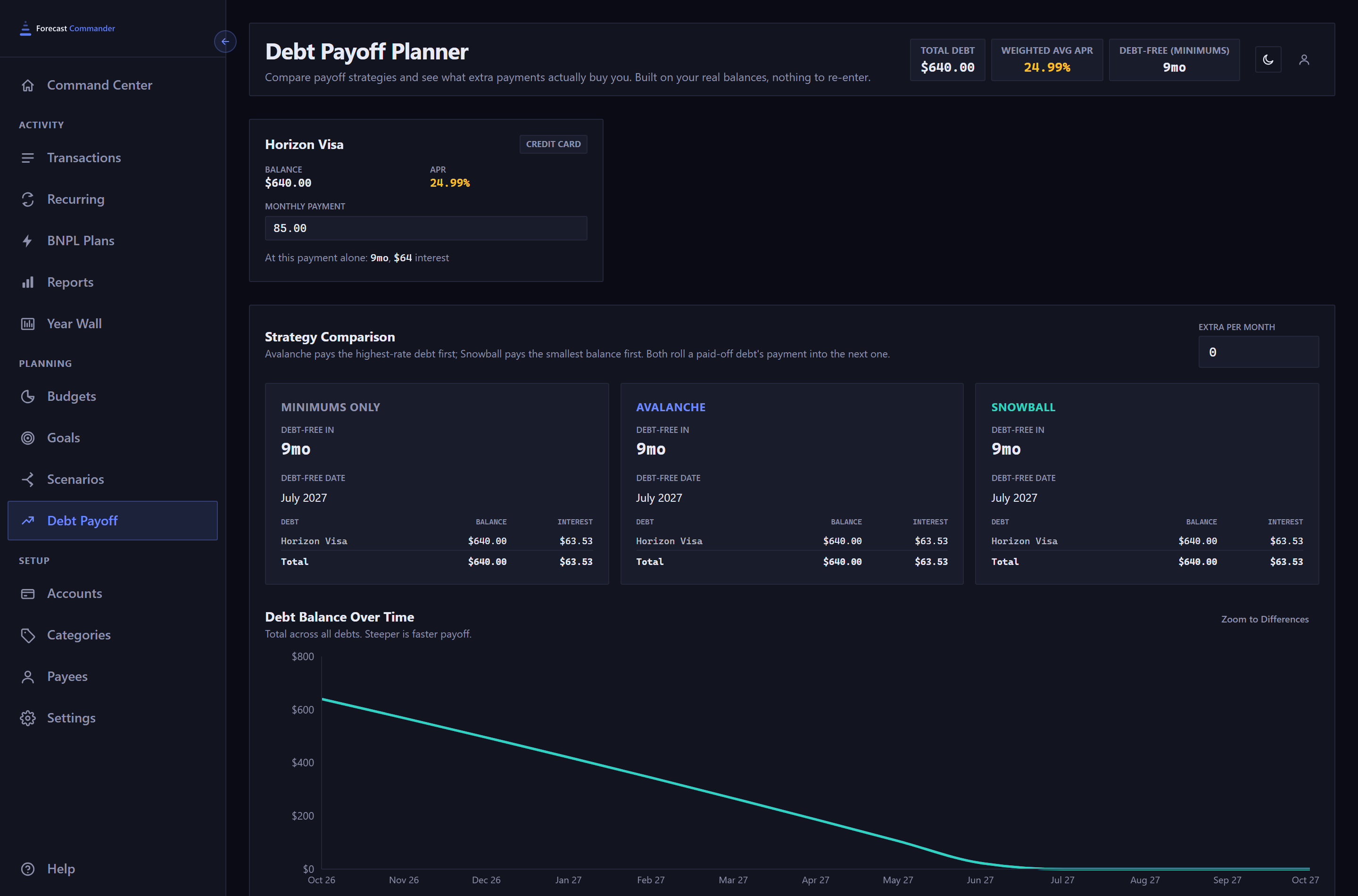
It covers credit cards, auto loans, mortgages and personal loans. Buy now, pay later plans are left out, since they're fixed, interest-free installments with their own page.
Rates and payments#
A debt joins the comparison once it has an interest rate and a monthly payment.
Debts missing a rate get their own section, headed Needs a Rate, with a field to add one inline. They're left out of every simulation until then.
The Monthly Payment field on each card is yours to change. It starts from what your recurring rules pay into that account, and editing it re-runs every projection on the page at once, so you can try a number without committing to it.
Avalanche, snowball, and the cascade#
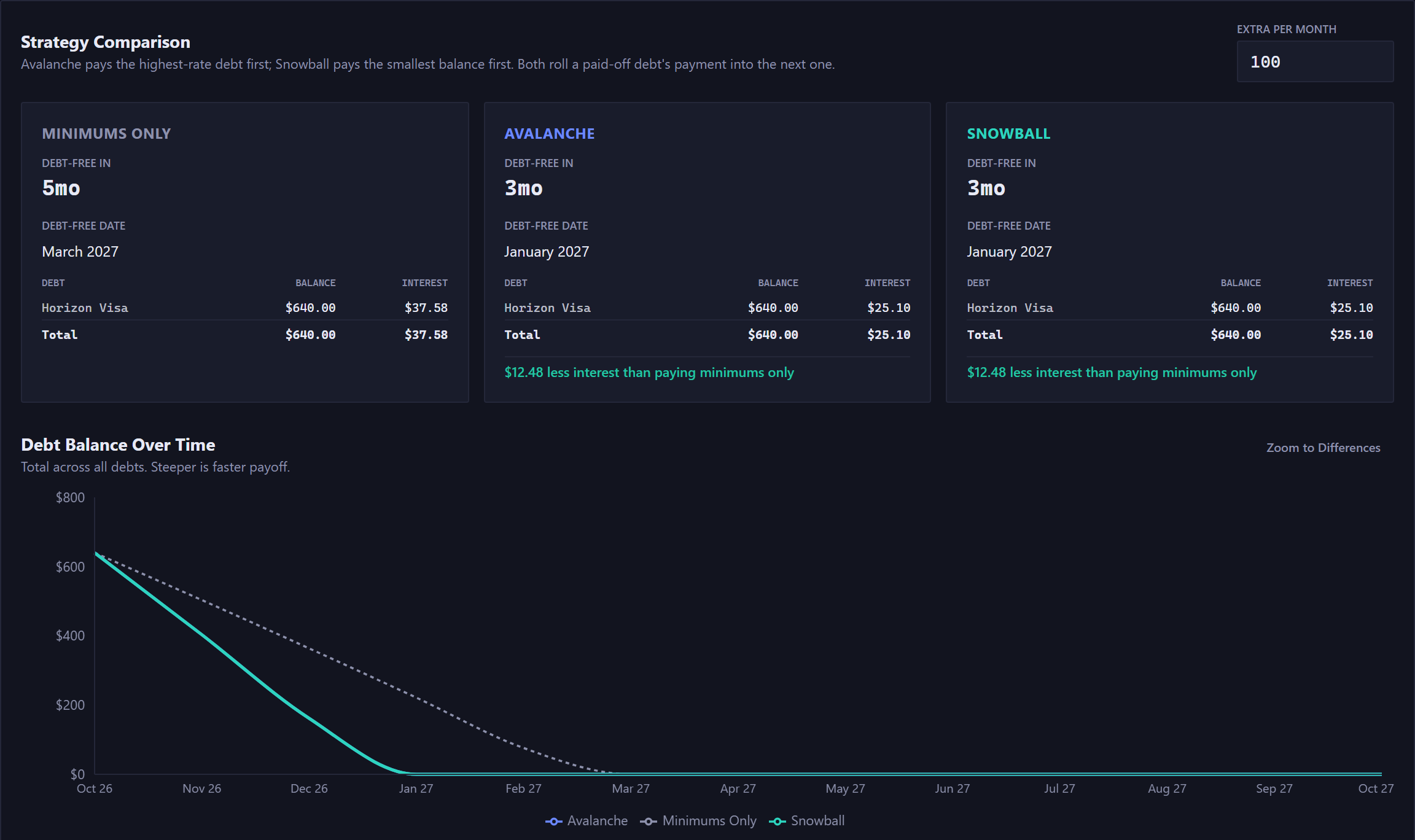
- Minimums Only
- The baseline. Each debt is paid down on its own, and money isn't redirected when one clears. The other two are measured against it.
- Avalanche
- Highest rate first. It always pays the least total interest.
- Snowball
- Smallest balance first. It clears individual debts sooner, at the cost of a little more interest overall.
Avalanche and snowball share a cascade. Every month, each debt gets its own minimum. Then a shared pool, made of your extra payment plus every minimum freed up by debts already at zero, goes to the top-priority debt still owing. Clear one and its payment joins the pool and goes to the next.
So a debt whose own minimum barely covers its interest can still be paid off under a strategy, but never under minimums alone.
With only one rated debt, avalanche and snowball give the same answer. They differ once you have several.
The two charts#
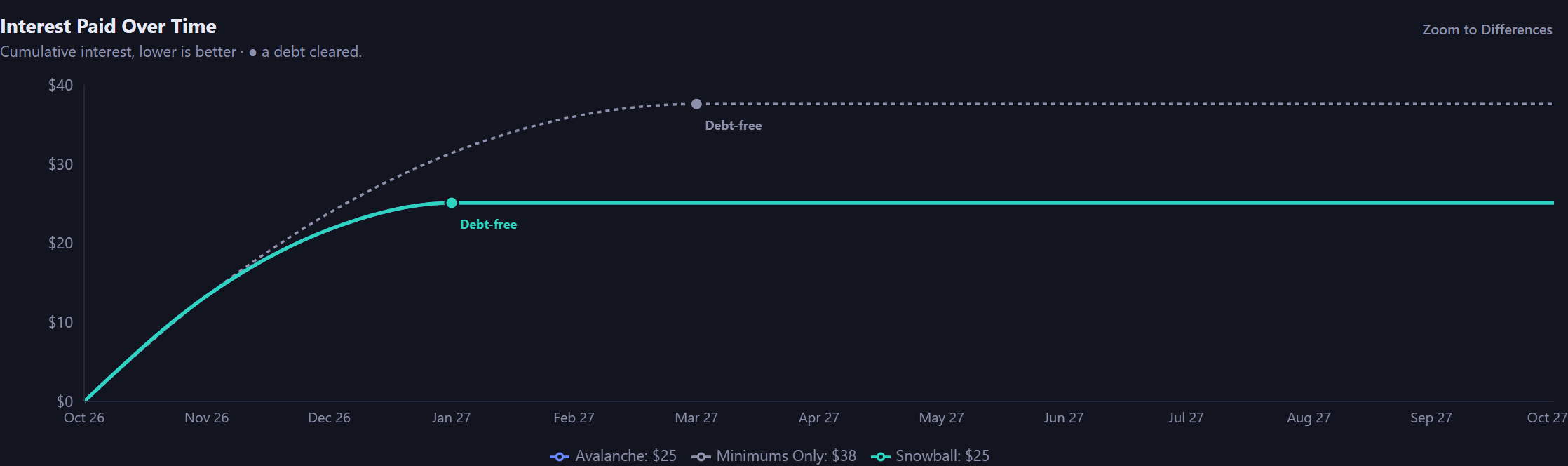
- Debt Balance Over Time
- Shows when you're done. Three lines fall toward zero, and steeper is faster.
- Interest Paid Over Time
- Shows what it costs. Three lines rise, and here lower is better. They flatten as debts clear, and a labeled dot marks each debt clearing, so you can read the payoff order off the chart.
Zoom to Differences on either chart trims the early months where the strategies are effectively identical, so the part where they differ fills the space. A note appears when the zoomed vertical axis no longer starts at zero.
What an extra payment buys#

Pick one debt and an extra monthly amount, and it tells you how much sooner the debt is gone and how much interest that saves. It works on that debt alone, separate from the strategies above.
Reading the payoff dates#
"Never pays off" means the payment doesn't cover the interest, so the balance never comes down. Interest only falls as the balance falls, so a payment that can't cover the first month never will.
The headline figure at the top of the page reads Never with an asterisk when some debt never clears at its current payment.
Every date here is a month and a year, never a specific day, since the planner works in whole months.
New here? See what Forecast Commander does.